Different people have different ideas on what constitutes programming. The Assembly coder will scoff at the C coder for using high level function calls, the C coder will belittle the C++ coder for using classes, the C++ coder will deride the C# coder for not managing her own memory and the C# coder will mock the VBscript coder simply because she can. In my experience a lot of programmers seem to consider those who use older or more primitive languages as ascetic sadomasochists who waste their time and effort doing things that could be automated, while at the same time ridicule those who use newer or more high-level languages for toying around with ‘fake’ programming.
My own definition of programming would only include a single constraint; execution. Anybody involved in any job that ultimately creates instructions that are executed by a computer, machine or even biological entity, can be said to be programming. This results in some interesting, and perhaps counter-intuitive, consequences. For example, the writing of pseudo-code does not count as programming, because no machine will execute the instructions. Until of course someone writes a compiler for pseudo-code, at which point it will suddenly become programming.
Every now and again I come across someone who feels that Grasshopper is not a programming language. The main reason for this seems to be the fact that one does not write textual source code when using Grasshopper, rather instructions are combined in a visual fashion using primarily the mouse rather than the keyboard. The user ayg011 on the Grasshopper forum recently took this position with a vengeance:
“Out of experience I can tell you that the problem you have would be solved via your own skill and intelligence in a matter of seconds, rather then clumsily relying on somebody else to write some code ‘packaged’ as a component, and ultimately restricting your capacity to explore novel design solutions in an intelligent way.
[…]
Its merely a toy for students and hobbyists. If you are just starting out, invest your time more wisely and learn something which can be used over the entire life cycle of project. It’s so versatile that you essentially have unlimited potential and all operations remain fully in your control, or put in another way; you’re not restricted by the idiosyncrasies of another programmer who’s ‘components’ might be totally unsuitable for a novel idea you may want to explore therefore killling it.” [link]
His point is somewhat novel in that he doesn’t so much focus on the textual vs. visual, but instead focuses on the fact that all operations in Grasshopper come in a pre-packaged form; as ready-made components. ayg011 seems to feel this limits the designer:
“True originality comes from the freedom of expression; GC allows this, where as preconfigured ‘components’ in GH have an intrinsic limitation.” [link]
To me, this signals a profound misunderstanding of what programming is. Unless you’re Charles Babbage, it is difficult to make the claim that you are truly programming from the ground up and not being limited in any way by what other programmers have done before you. I would defend the position that there is no difference —none whatsoever— between this algorithm:
public Vector3d VectorFunc(Vector3d A, Vector3d B)
{
  A.Unitize();
  B.Unitize();
  return A + B;
}
And this one:
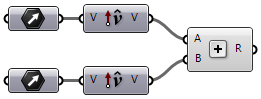
Whatever language you are programming in, you will always be initially limited by the SDK that other programmers have put together for you. If you have access to fine-grained operation (vector addition for example) you can always extend the SDK with your own functions as you see fit. Just like you can always write a novel story using a 26 character alphabet, you can always write a novel algorithm using a limited number of basic functions. This is what’s known as universality in computational theory.
ayg011 has a further objection, one with which I find myself far more aligned:
“My main concern is that the close-ended style of GH is going to trigger a generation of designers to plan their creativity around components they know exist in the software (so a tower becomes this identikit style of architecture that ‘twists’, or has a hexagonal parametric skin etc), rather then seeing it as a tool to realise whatever their imagination can think of (the beauty and strength of GC)” [link]
This is indeed a fundamental problem that faces us all. The easier it becomes to achieve something, the higher the likelihood that someone will achieve it without fully understanding it or without having an actual need to do it. Both are deplorable outcomes. It strikes me as a poor solution though to complicate the software to ensure only those with ‘true grit’ will be able to make headway.
This is a problem caused by easy-to-use software, but it is a problem that must be solved by better education. As an employee of a CAD firm, my job is to make it easier and easier for my users to construct the geometry they want. As a teacher at a university or college, it is your job to make sure that new tools are used sagely.


 Bugs for breakfast
Leave a reply to Ángel Linares (@_aLinG_) Cancel reply